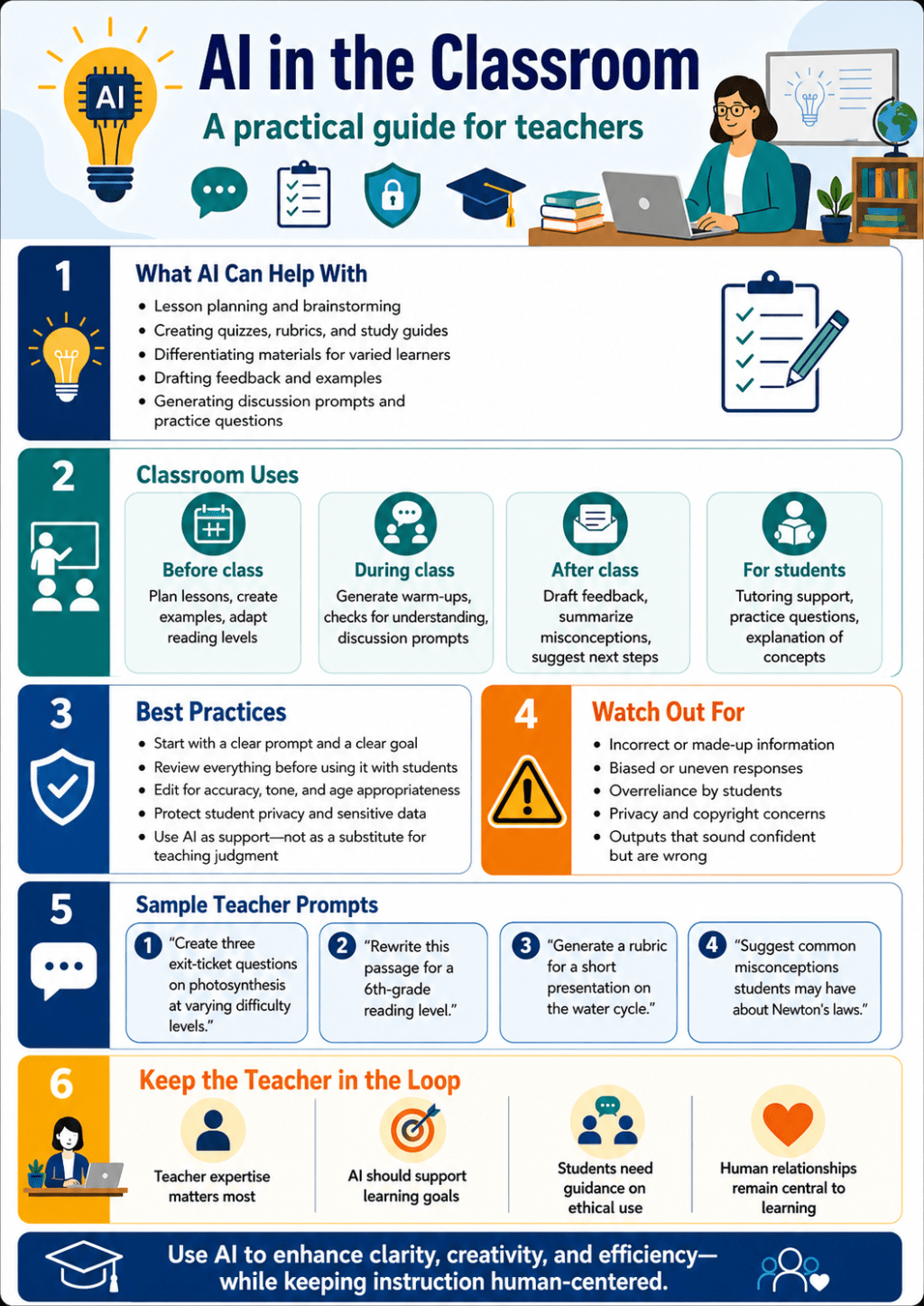
Everyone loves a good infographic! At least, I know I do.
Over the past few days, I have seen a lot of infographics popping up on social media feeds like Facebook and LinkedIn. Many of them focus on AI in education. Since AI does not actually teach in a classroom, I thought I would try making my own infographic using ChatGPT and see what happened.
Here is the prompt I used:
Create an infographic about using AI in the classroom. Make teachers the intended audience.
This is a very simple prompt. I know I could probably get better results with a more detailed prompt, but I wanted to experiment and see what ChatGPT would produce with minimal guidance. I encourage you to try the same prompt and compare your results.
This is what ChatGPT made:
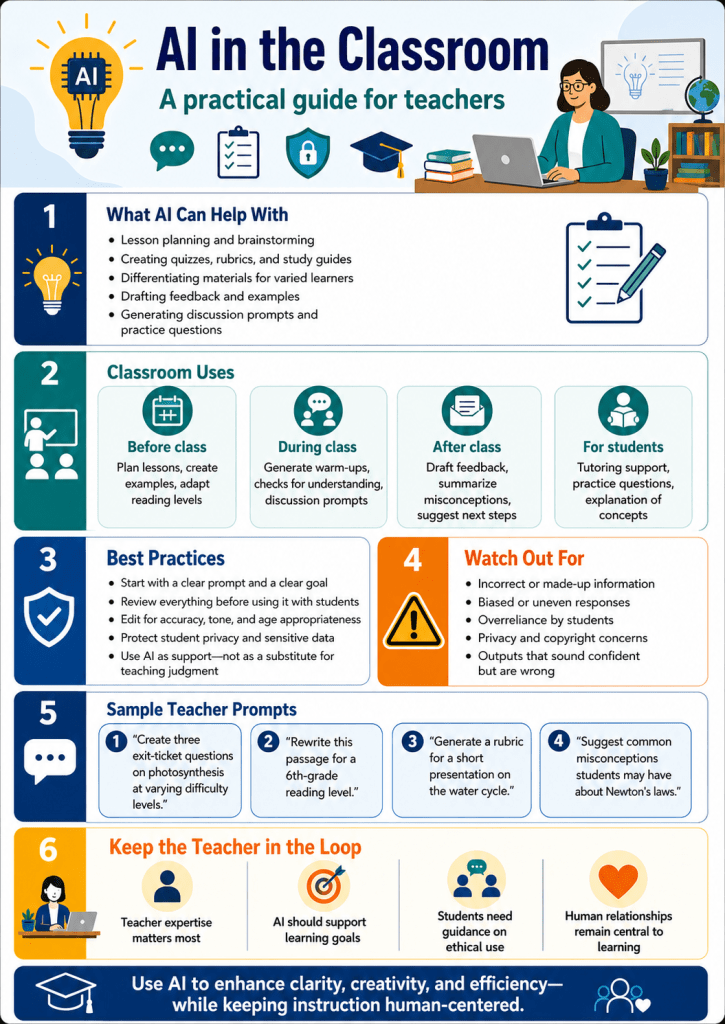
That is pretty cute, and there are some good tips. My critique, though, is that it leans heavily toward a transmission model of teaching. In other words, it focuses more on delivering information, organizing content, and helping teachers manage instruction. Those things are useful, but they are not the whole picture.
What it neglects is inquiry learning.
So I modified the prompt:
Create an infographic about using AI in the inquiry-driven classroom. Make teachers the intended audience.
This is what ChatGPT produced the second time:
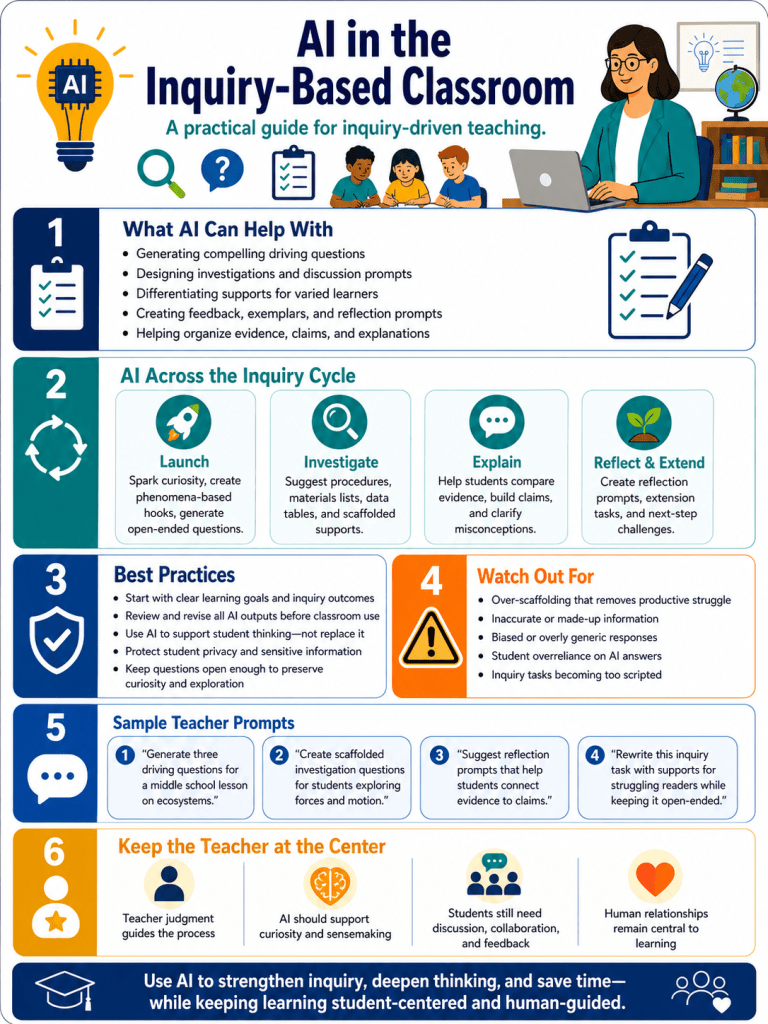
My first critique of this process is this: at this point in the education game, the default bias should be toward inquiry learning.
Inquiry learning should be the norm now.
When I say inquiry learning, I am not just thinking about a simple 5E lesson model. I am thinking about project-based, problem-based, authentic inquiry where students investigate meaningful questions, wrestle with evidence, build explanations, test ideas, revise their thinking, and create something that demonstrates understanding.
AI can help us move in that direction. It can help teachers design better questions, create realistic scenarios, scaffold student thinking, generate feedback, support differentiation, and build more authentic learning experiences.
But we have to ask it to do that.
I would argue that we must make inquiry the default if students are going to learn deeply in the age of AI. If students can use AI to quickly summarize, answer, or generate surface-level work, then our classrooms have to move beyond simple information transfer. We need learning experiences that require curiosity, judgment, creativity, collaboration, and reasoning.
LLMs are biased, at least right now, toward the largest quantity of available information on a subject. That is part of how these models work. They are trained on existing data, and much of the education-related material available online still reflects traditional models of teaching.
So when we ask a broad question like “How can teachers use AI in the classroom?” we should not be surprised if the answer defaults to traditional classroom structures.
But as the second prompt shows, it is not hard to steer the model toward better instructional design. A small change in wording can shift the output from “AI as a tool for managing instruction” to “AI as a tool for supporting inquiry.”
That matters.
My challenge for you is to try both prompts with your favorite AI tool:
Create an infographic about using AI in the classroom. Make teachers the intended audience.
Then try:
Create an infographic about using AI in the inquiry-driven classroom. Make teachers the intended audience.
Compare the results. What changes? What stays the same? Does your AI default to traditional instruction, or does it support inquiry?
I would love to see what different models produce for different people, so please post what your AI generates.


Leave a Reply